

Laser technology has become one of the most effective solutions for tattoo removal, pigmentation correction, and skin rejuvenation. Among the most widely used systems in aesthetic clinics are the Picosecond Laser and the Q-Switched Nd:YAG Laser. While both devices use the principle of selective photothermolysis to target pigment particles, significant differences exist in pulse duration, treatment efficiency, patient comfort, and clinical outcomes.
Understanding these differences can help clinic owners, distributors, and aesthetic professionals choose the right technology for their business and treatment goals.
What Is a Q-Switched Nd:YAG Laser?
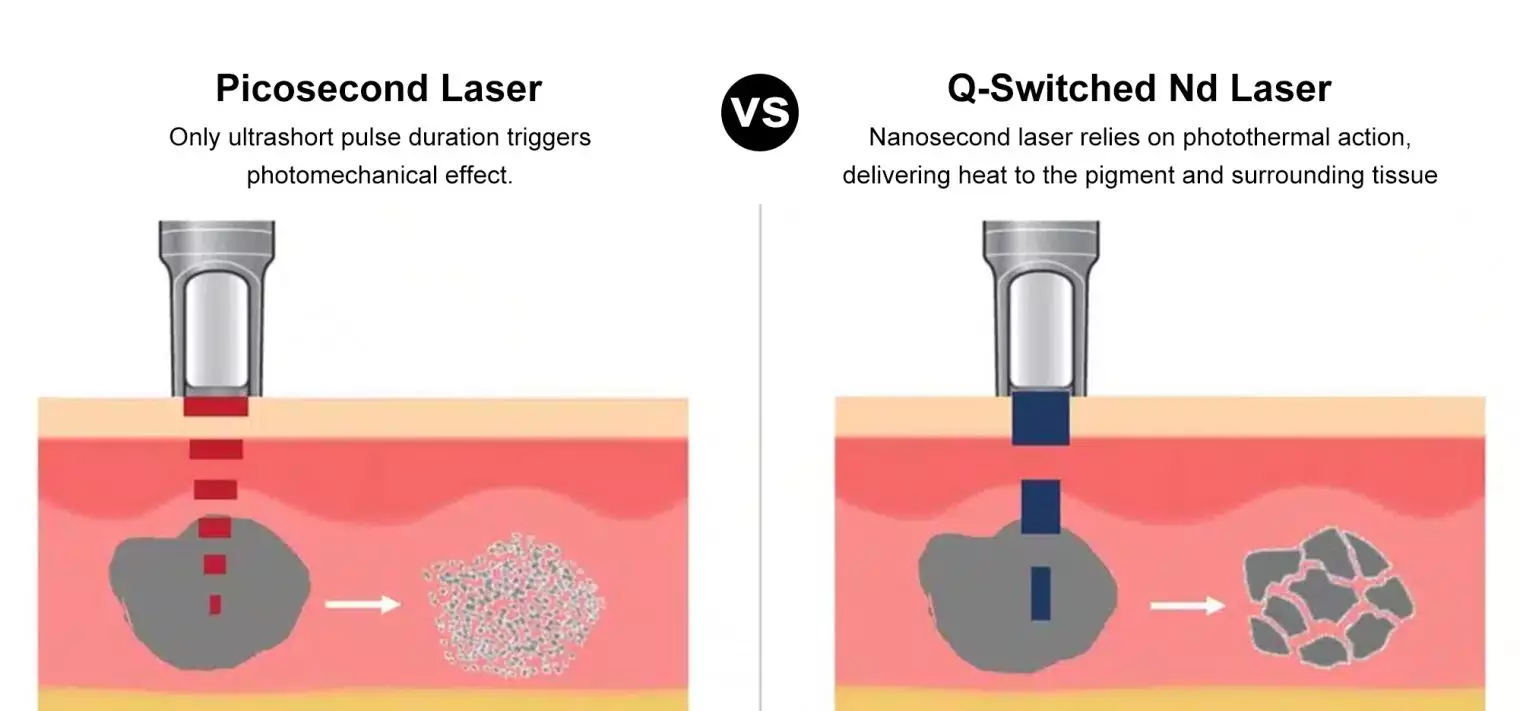
A Q-Switched Nd:YAG Laser delivers high-energy laser pulses in the nanosecond range (one billionth of a second). It has been widely used for decades to treat:
- Tattoo removal
- Melasma
- Freckles
- Age spots
- Nevus of Ota
- Pigmented lesions
The most common wavelengths are:
- 1064nm for dark pigments and deeper lesions
- 532nm for red, orange, and superficial pigmentation
Q-switched technology breaks pigment particles into smaller fragments that can be naturally eliminated by the body’s lymphatic system.
What Is a Picosecond Laser?
A Picosecond Laser is an advanced version of pigment-removal technology that emits laser pulses in picoseconds (one trillionth of a second).
Because the pulse duration is approximately 1000 times shorter than a nanosecond pulse, the laser creates a stronger photoacoustic effect while generating less thermal damage to surrounding tissues.
Picosecond lasers are commonly used for:
- Tattoo removal
- Melasma treatment
- Pigmentation correction
- Acne scar improvement
- Skin rejuvenation
- Pore refinement
The ultra-short pulse duration allows pigment particles to be shattered into much finer fragments, making them easier for the body to remove.
Picosecond Laser vs Q-Switched Nd:YAG Laser
1.Pulse Duration
| Feature | Picosecond Laser | Q-Switched Nd:YAG Laser |
| Pulse Width | Picoseconds | Nanoseconds |
| Speed | Faster | Slower |
| Energy | More precise | Less precise |
The shorter pulse duration of a picosecond laser enables more efficient pigment fragmentation with less heat accumulation.
2.Tattoo Removal Performance
Picosecond lasers are generally considered more effective for tattoo removal, particularly for:
- Multi-colored tattoos
- Resistant tattoo ink
- Professional tattoos
- Previously treated tattoos
Compared with traditional Q-switched systems, picosecond lasers often require fewer treatment sessions to achieve similar or superior clearance results.
3.Pigmentation Treatment
Both technologies can effectively treat pigmentation issues such as:
- Sunspots
- Freckles
- Age spots
- Post-inflammatory hyperpigmentation
However, picosecond lasers provide greater precision and lower risk of thermal injury, making them increasingly popular for treating complex pigmentation concerns.
4.Skin Rejuvenation Benefits
One major advantage of picosecond technology is its ability to stimulate collagen production.
Many modern pico laser systems include specialized fractional handpieces that can improve:
- Acne scars
- Enlarged pores
- Fine lines
- Skin texture
- Overall skin quality
Traditional Q-Switched Nd:YAG Lasers are primarily designed for pigment removal and generally offer fewer skin rejuvenation benefits.
5.Recovery Period Comparison
| Comparison dimensions | Q-Switched Nd:YAG Laser | Picosecond laser |
| Recovery period | About 7–10 days; scabbing may occur. | Approximately 3–5 days; minimal damage to the epidermis. |
| Postoperative reaction | Redness, swelling, a burning sensation, and possible bruising. | Mild redness; typically resolves within 1–3 days. |
| Number of treatment sessions | Requires 3–5 sessions. | Generally effective after 1–3 treatments. |
Picosecond Laser vs Q-Switched Nd:YAG Laser, Which Laser Is Better for Clinics?
The answer depends on your clinic’s target market and budget.
Choose a Q-Switched Nd:YAG Laser if:
- You are entering the aesthetic market with a limited budget.
- Your primary focus is tattoo removal and pigmentation treatments.
- You need a reliable and cost-effective laser platform.
Choose a Picosecond Laser if:
- You want premium treatment offerings.
- You target high-end aesthetic clients.
- You need superior tattoo removal performance.
- You want additional skin rejuvenation capabilities.
- You aim to differentiate your clinic from competitors.
Why Many Clinics Are Upgrading to Picosecond Technology
As patient expectations continue to rise, clinics are increasingly seeking treatments that deliver faster results with less downtime.
Picosecond lasers offer:
- Faster pigment clearance
- Better tattoo removal outcomes
- Improved skin rejuvenation
- Enhanced patient experience
- Greater treatment versatility
These advantages have made picosecond technology one of the fastest-growing segments in the medical aesthetic industry.
Picosecond Laser vs Q-Switched Nd:YAG Laser Conclusion
Both Picosecond Lasers and Q-Switched Nd:YAG Lasers remain valuable tools for pigmentation and tattoo removal treatments. While Q-switched systems continue to provide reliable and affordable performance, picosecond lasers offer significant advantages in treatment speed, precision, patient comfort, and skin rejuvenation.
For clinics seeking advanced technology and premium treatment results, investing in a professional Picosecond Laser Machine may provide a strong competitive advantage in today’s aesthetic market.
Product recommend
Picoseond Laser Machine Recommend
Q-Switched Nd:YAG Laser Machines Recommend
You may also interested: Top 10 Beauty Machine Factory in China: 2026 Manufacturer Ranking for B2B Buyers